


What You're Really Getting When You Buy an Original Print
The word "print" has a problem. It's used for a hand-pulled linocut that took weeks or even months to make, and it's used for a poster run off in thousands. Same word, very different objects. The confusion is often palpable when I say "these are handmade original prints" at craft fairs; more than one person has responded with a chuckle and "that's a contradiction in terms" and then been told why it's not. Printmakers spend their lives trying to untangle the meanings and remove the notion that 'print' must mean quick, computer related or easy. An original print, for me, is none of those things. Here's my attempt to explain, plainly, what you're actually getting when you buy an original print from me, and why I think it matters.
The print is the artwork
With a painting, you own the one and only original. With a reproduction, you own a copy of something that exists elsewhere. An original print sits in a third category. The Royal Society of Printmakers (RE) puts it simply: the print itself is the original artwork, and the image doesn't exist anywhere else in any other form. In short, it is not a copy of some other piece of art, it is the art. Confusion creeps in because depending on the printmaking technique you can make multiple copies of the same image, but they are all originals.... confused? Stick with me, this will make sense!
When I made my Wetlands Monotypes I put printmaking ink onto a perspex plate, manipulated it using brushes, cloths, card and other tools, whilst referring to sketches made on location, then ran the plate through the press to transfer the image to a piece of paper. That was it, one impression, one original image, hence ‘mono’ it only exists once. These are usually the most expensive type of print as each image exists only once, just like a painting, except it used a printmaking technique to make it.

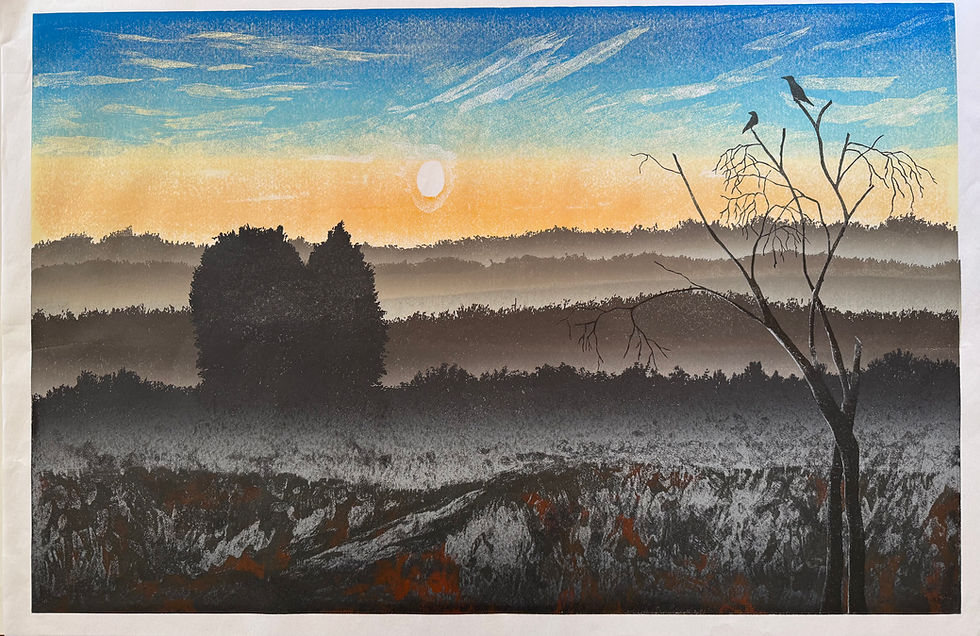
In contrast, the reduction linocut Dawn Sentinels exists as an edition of 10. There was still no painting or photograph behind it waiting to be copied. I worked from sketches made in Chobham Common and the image was drawn, carved, inked and pressed into existence as a linocut. The image exists only in that form; there are 10 original images in the edition, each one ever so slightly different and each one original. There were 16 pieces of paper that I tried to get that image on, but 6 of them didn't make the edition since they were too different for varying reasons (some went wrong, some were testing colours or cuts), this is normal and why I start with more than I want to end up with when I make multi-layered works.
Decisions you can't take back
Dawn Sentinels is a reduction linocut, made with two plates. In a reduction print, you print a colour, carve away part of the block, then print the next colour over the top. Each cut removes something permanently. There's no going back once you make a cut.
Apparently Picasso used the term 'suicide lino' for this technique - you can't put back anything you have removed from the lino. This means you can never go back and make that print again, you will only have as many in the edition as you start with. Once an edition is sold it's gone. When you look at a reduction print, you're looking at a series of irreversible decisions that all had to work together to build up the image.

Made by hand, so never mechanically identical
Every layer of every print I make is individually inked and pressed, which means small variations from one impression to the next. That's not a flaw, The RE describes each numbered print in an edition as an individual, handcrafted part of the whole, each ever so slightly different from the last. A machine-made reproduction will aim for perfect sameness. A hand-pulled print carries the marks of the person who made it. Even when the whole image is carried on one plate and inked in one colour, it is still inked by a hand, so there will always be slight variations. The printmaker might be aiming to make the whole edition as consistent as possible, but the printmaker is a human, not a machine.
What "limited edition" really means
When I say Dawn Sentinels is an edition of ten, I mean there will only ever be ten. That's a real limit, and it's the reason original prints are collectable in a way posters aren't. Because each impression is itself an original, an edition isn't ten copies of one artwork. It's ten originals of the same image.
Stitchwort is an etching in an edition of 25. This means once I have printed 25 in black from that plate I won’t ever print any more. I will either ‘cancel’ the plate by damaging it on purpose so it physically can’t be reprinted, alternatively I could produce a new edition in a different colour or rework the plate to change the image. The edition sold in the current state and colour will never number more than 25. There was a fascinating episode of Fake or Fortune (BBC) in which they tried to uncover whether a series of prints was by Lucian Freud. *Spoiler alert* they couldn't decide... the fact they weren't signed and numbered as an edition meant that even if they were by him they couldn't be sold as authorised copies. This is why printmakers who work on metal plates where the whole image is carried on that one plate will often cancel the plate once the edition is printed - leaving the plate intact makes it very easy for unauthorised copies of your work to be made. It is also why we sign test prints and artists proofs.
Signing and numbering are useful, but they aren't what makes a print original. Many painters will reproduce a painting as a digital image (a scan or a photograph) printed by machine onto archival paper using archival inks in a limited run, they will sign and number the prints and (depending on the artist) they may command huge sums for a reproduction, but less than the original painting. These are digital reproductions of an image that exists as an original in another form (a painting); they might still be limited in number but they're not 'original'. This is not to say that they're not valuable, I have a limited edition and much treasured Quentin Blake print, I can't afford an original so this is a brilliant way of making art affordable, but please don't assume that just because it's limited edition or signed that it's automatically an original.
A note on digital
There are many artists that produce prints using digital technology and only ever print a limited number onto paper. The image is conceived as a print from the start which makes these as valid as those produced by more traditional techniques. In this case the whole edition will be identical but since the image only exists in that form and is not a reproduction of an image that exists in another form they are original prints. Suzanne Moxhay ARE is such an artist, it's the same test again: was this image conceived as a print, by the artist, or is it a copy of something else?
How to tell what you're buying
These questions can help you identify what exactly you're getting:
Was the image made as a print, or copied from another work? Make sure you know whether you're buying an original or a reproduction. Reproductions should be cheaper than the original.
Which technique was used? An artist should be able to tell you, and ideally show you how it's made.
Is there an edition size? A fixed number means real scarcity; some prints may be ‘open edition’ (there's no limit to how many the artist will make) and you should expect to pay less for these.
Was it made by the artist? Artists do sometimes work with master printers who can take care of the technicalities of the printmaking processes but the idea for the work will be the artist's own and usually the drawing on the plate etc. will have been done by them. Particularly in lithography a master printer may have processed the plate/stone and completed the printmaking process once the artist was happy with the image & colours etc. For example Emma Stibbon RA often works with a master printer.
Can the maker explain the work? An artist will be able to explain the full concept and context behind their work; individual works of art are usually part of a much bigger investigation by an artist. A true artist will never make something ‘because I thought it would sell’, they will be exploring a concept, idea and/or context which they will be able to tell you about and which may become apparent when you see multiple works by the same artist, e.g. Chris Orr is fascinated by the idea of utopia and explores this through multiple different characters and situations.
Why I think it's worth it
Bankside Gallery, home of the Royal Society of Printmakers, describes original prints as a brilliant way to start an art collection on a budget, and I agree. You can live with a real, hand-made artwork, with its own history and a limited number of siblings, by iconic artists, without the enormous price of a painting. Don't get me wrong, prints are (and should be) expensive, but if Dawn Sentinels was an oil painting it would have a big four figure price tag on it. Because it's a print and there are 10 of them I can price the whole edition of 10 at four figures but ten lucky owners get to enjoy it and share that cost, not just one!
What I'd most like you to take away is this: a print I've made isn't a stand-in for a more important original somewhere else. It is the original. It started on a heath at dawn or in a Norfolk marsh, passed through my sketchbooks, my plates and my press and ended up on paper in front of you. I work in print because I adore the processes, the technicalities involved in making prints are part of the appeal for me. While I'm delving into the landscapes I adore I'm also exploring centuries of craft, revelling in the joy of making something by hand and experiencing the thrill of peeling back the paper from the plate to see what I've got - you just can't beat that part!
If you'd like to see how a print is made, or see one in person, studio visits are welcome by appointment. Just email me at jo@joboddy.co.uk and you can alway watch process videos and see what I'm up to via my socials. If you'd like to peel back your own print from a plate I run linocut workshops.


Comments